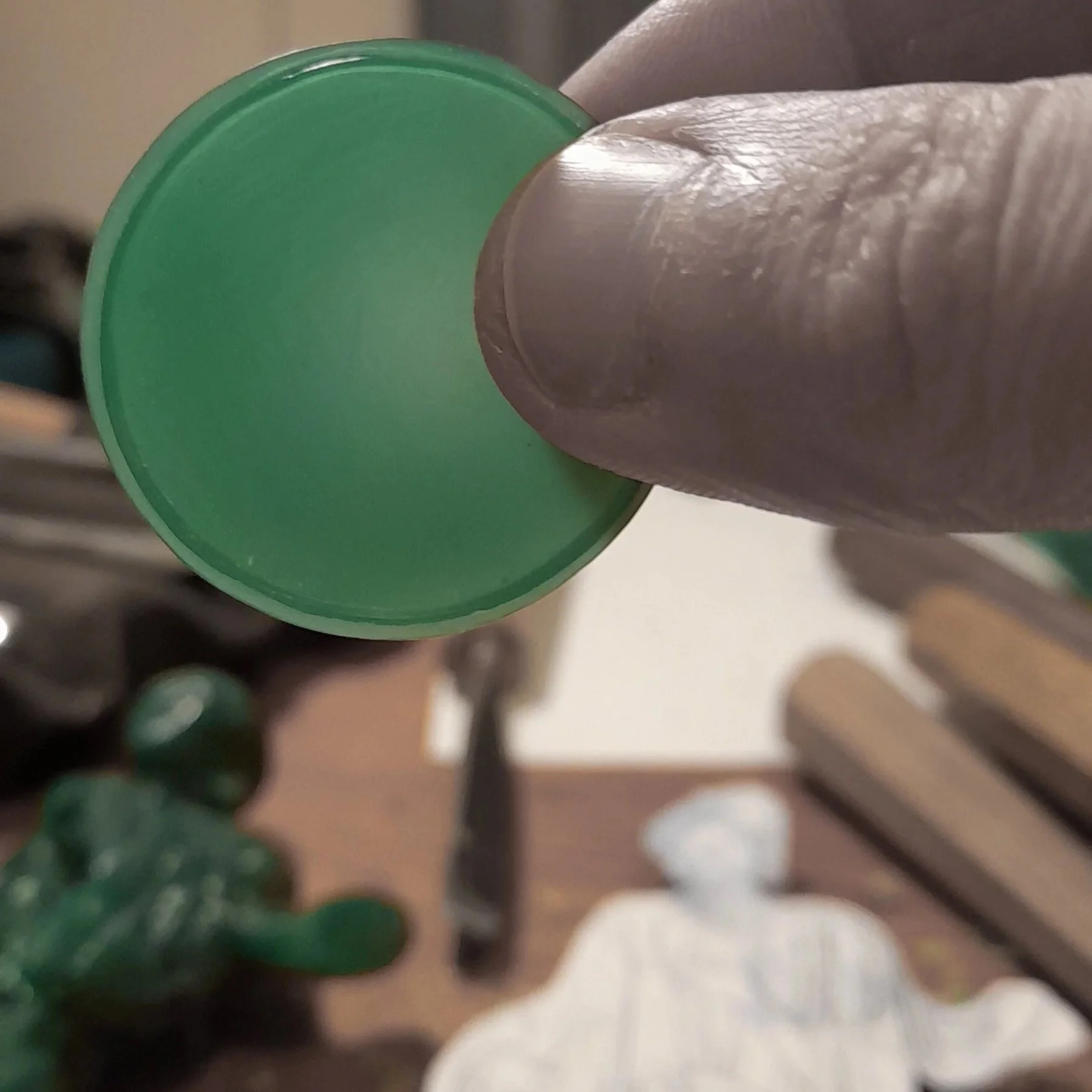
A halo in green wax for an angel carved in wax. The angel was then cast in bronze and smaler elements in gold (see image gallery)
I can spend hours looking at a little band of paint. I know it as the Flügelbänder and Tänien (1), these refer to the ribbons on their hair and the crossed bands on their wings and I look for it when I study the archangel Uriel in the crypt of Marienberg Abbey in South Tyrol. I want to see where the strokes meet and whether I can tell which came first. This is a habit from carving: even when I’m completely taken with a figure, part of me wants to know how somebody got a line to go that way.
On my first visit I was struck by the slender bodies and wings against the blue. That blue was made from lapis lazuli coming from Afghanistan over the silk road.(1) In the turns of the painted line I can still imagine a hand moving quickly over plaster that hadn’t yet set. God, if I’m going to use a capital G, seemed to speak to me there through the painter’s knowledge of what a little ground stone could do. I don’t often use the word ecstasy, but it’s closer than admiration to what I felt. It was as though the blue were making me aware of a light I couldn’t see.
The monks of Marienberg came into this room to pray in the twelfth century (2). It matters, I think, that the angels are painted around you. I sometimes think of a sacred image as a window, with myself on one side and what I’m looking at on the other. At Marienberg I had the sensation of being already among the angels. In Die Engel von Marienberg im Licht spiritueller Deutung, Mechthild Clauss reads the frescoes as a heavenly Jerusalem still being built, in which human beings have a part to play (3).
The passage I keep going back to in her book begins nowhere near heaven. A woman in Luke’s Gospel loses one of her ten coins. She lights a lamp and sweeps the house until she finds it. Gregory the Great sees the woman as divine Wisdom and the coin as humanity estranged from God. The lamp is a flame in a clay vessel: God come in the flesh. The sweeping is what happens in us when that light comes on. It shakes the conscience awake, and in seeing what has separated us from God we begin to see a way back. In Gregory’s reading, humanity restored makes up the tenth order alongside the nine orders of angels (4).
In Scivias, Hildegard of Bingen imagines human beings taking up the praise left unfinished after Lucifer’s fall. What she asks of them is humble obedience and the practice of virtue (5). I suppose I had thought of heaven as the one place where everything would already be in order. I look up at the painted angels differently when I think there is still room for another voice.
I’m not always sure what to do with Tugend in English. Virtue can sound like something you possess. Hildegard is talking about something you practise. I don’t think she meant the same thing I do when I speak of a calling. But she makes me think about what I do with mine on an ordinary working day. How much of myself am I willing to give to the work, and how much of what I know am I willing to share? I can’t tell what sort of person painted those wings. But looking up, I still have the sense that someone is showing me how a line can turn. There’s a generosity in that, whether the painter could have imagined me standing there or not.
You would think it would be easy to stay with a subject that has held your attention for so long. In the workshop a commission comes in, another idea looks promising, and by the time I get back to what I was doing I’ve lost the thread. I’ve talked with older makers who are starting to catalogue their life’s work, sometimes quite reluctantly, because the pieces have gone off in all directions. I’m struck by how long some of them have stayed interested in what looks, from the outside, like a single idea. I think of that as a refrain, and mine is in the crypt at Marienberg. It has become a kind of library for me, though I seem to be reading the same few pages.
When I carve the angels, the rest of my body goes quiet in much the same way it does when I stand in front of something beautiful. My eyes and hands are very much awake. Sometimes I take off so little wood that the change is easier to see in the way the light falls than in what’s come away. A turn of the brush can be over in a moment. It can take me a long time to find how to keep that movement in a line that also has to make sense when I turn the figure sideways. Abbot Markus Spanier of Marienberg, commenting on one of the carvings, spoke of keeping “the gracefulness of the painted angel” in wood. I was glad he noticed. It’s easy to get the outline right and lose the movement.
A family who received one of my seraphs wrote to say it was still on the piano. They were looking for a place that would be safe but also mittendrin, in the middle of things. The one-year-old smiled at it. The five-year-old said it couldn’t be an angel. She’d never seen anything that beautiful. The eight-year-old didn’t know what to say at first. Then he called it a miracle and said he wanted to erarbeiten it. “Work it out” might be one way of putting it, though I hear in the German something closer to wanting to work at it himself. I don’t know what he meant to do, exactly. As a woodcarver I liked that he reached for a verb with work in it.
I keep thinking about the seraph on that piano. It didn’t yet have its proper place in the house, but in the meantime the children had each made something different of it. I could spend all the time I liked at the bench and still not have arranged any of that. It’s part of what I mean when I say that beauty is an encounter. At Marienberg I was the one looking up. Someone else had already done what could be done with a brush.
There is one thing I can decide at the bench, and that is what wood I begin with. A piece can be excellent for carving and still be wrong for the angel. What I know about where it grew, or about the life it has already had, can change the way I understand the figure I’m making. I like that an angel, which is supposed to belong to heaven, can come out of something that grew in a particular patch of earth.
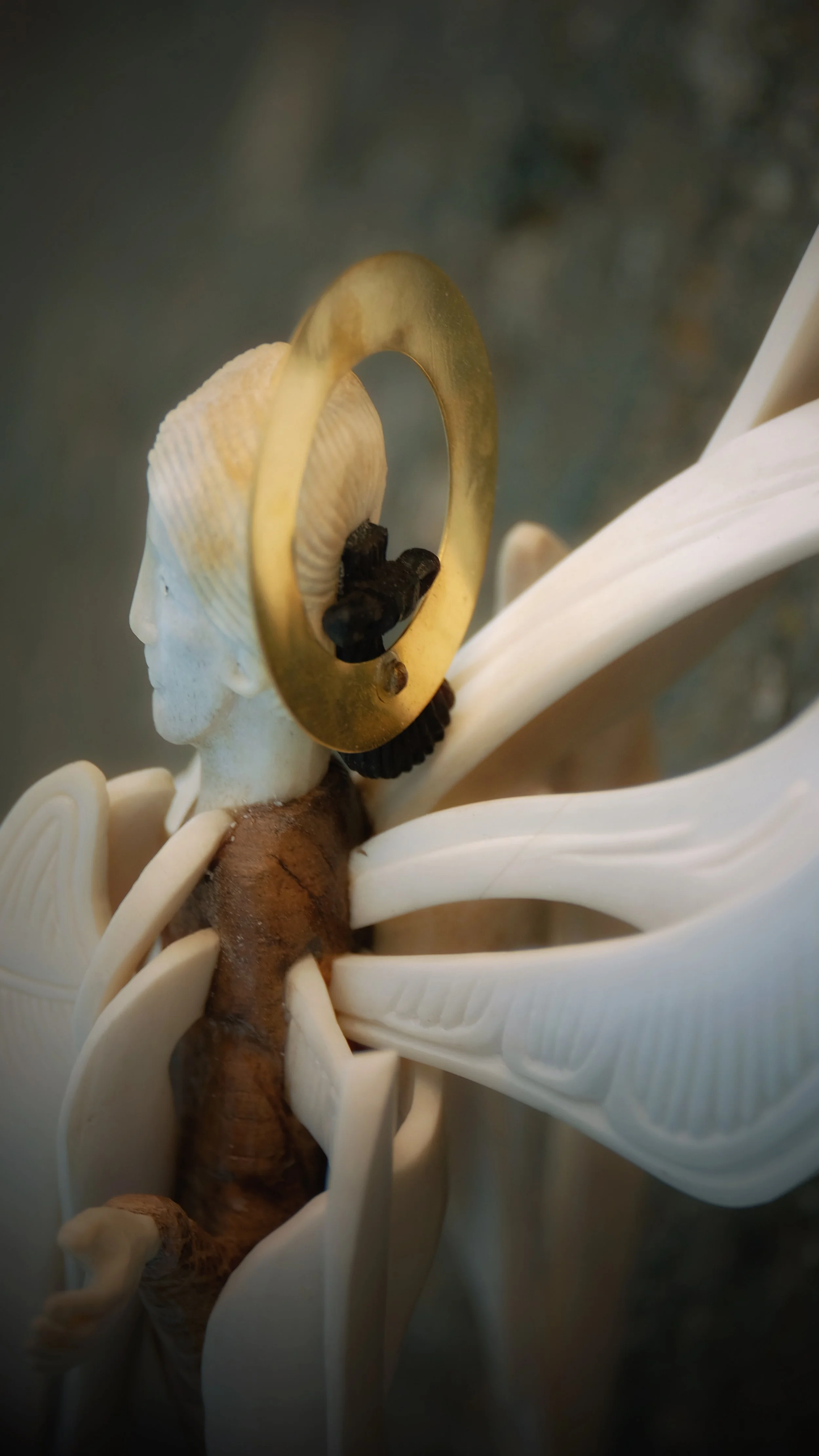
For one of my recent seraphs I worked in oak and carved the wings from elk bone. I fitted them at an angle so their sweep would suggest a spiral, as though they were following something. I set a halo of very thin brass on the head. It shone a deep gold when it caught the light.
I think here of what Orthodox theology calls ungeschaffenes Licht, or uncreated light. It is the divine light revealed in Christ’s Transfiguration. Painters of that scene have found ways of suggesting it with pigment (6). I come up against something similar at the bench. I can carve the turn of a wing. I can’t carve the light it’s turning towards.
In my mind the seraph was turning in the light of God. I
thought of the way a tree turns as it grows towards the sun. Sometimes you can follow that movement in a branch without looking up to see the sun at all. I wanted something of that turn to stay in the wings even when the brass didn’t catch the light.
Notes
1. H. Stampfer and H. Walder, Affreschi romanici in Val Venosta (2004), pp. 69–70, as cited in a discussion of lapis lazuli in Romanesque painting.
2. Marienberg Abbey, Foundation church and crypt.
3. Mechthild Clauss, Die Engel von Marienberg im Licht spiritueller Deutung (EOS Verlag).
4. Luke 15:8–10; Gregory the Great, Homily 34 on the Gospels, §6.
5. Hildegard of Bingen, Scivias, III.2.19. English excerpt and commentary.
6. Greek Orthodox Archdiocese of Canada, About the Transfiguration.