Conversations Across the Workbench
The history of regional woodcarving traditions in Norway is often preserved not through formal documentation, but through tools, objects, and the continuity of practice across generations. Figures such as Jon Olsson Rustom (b. 1863, Rustom, Vågå) and later Johannes O. Myrum (b. 1896, Vågå) exemplify this mode of transmission, in which knowledge is embedded less in written records than in the disciplined repetition of making.
Jon Olsson Rustom’s life traces a familiar trajectory of the late nineteenth and early twentieth centuries. At the age of twenty-two, he emigrated to America, before returning to Norway around 1914 to care for his parents. His practice as a woodcarver developed within a broader familial network of skilled makers, including silversmiths, carpenters, and woodcarvers. His production ranged from small-scale domestic objects—picture frames, mirror frames, and butter molds—to more structurally integrated items such as carved wooden porridge bowls (grautembere), towel racks, and furniture. These works occupied a space between utility and ornament, reflecting both local demand and inherited formal vocabularies. Initially reliant on objects made by Sjugurd Grevusten, Rustom gradually internalized the necessary techniques, producing such forms independently and adapting them to context and need.
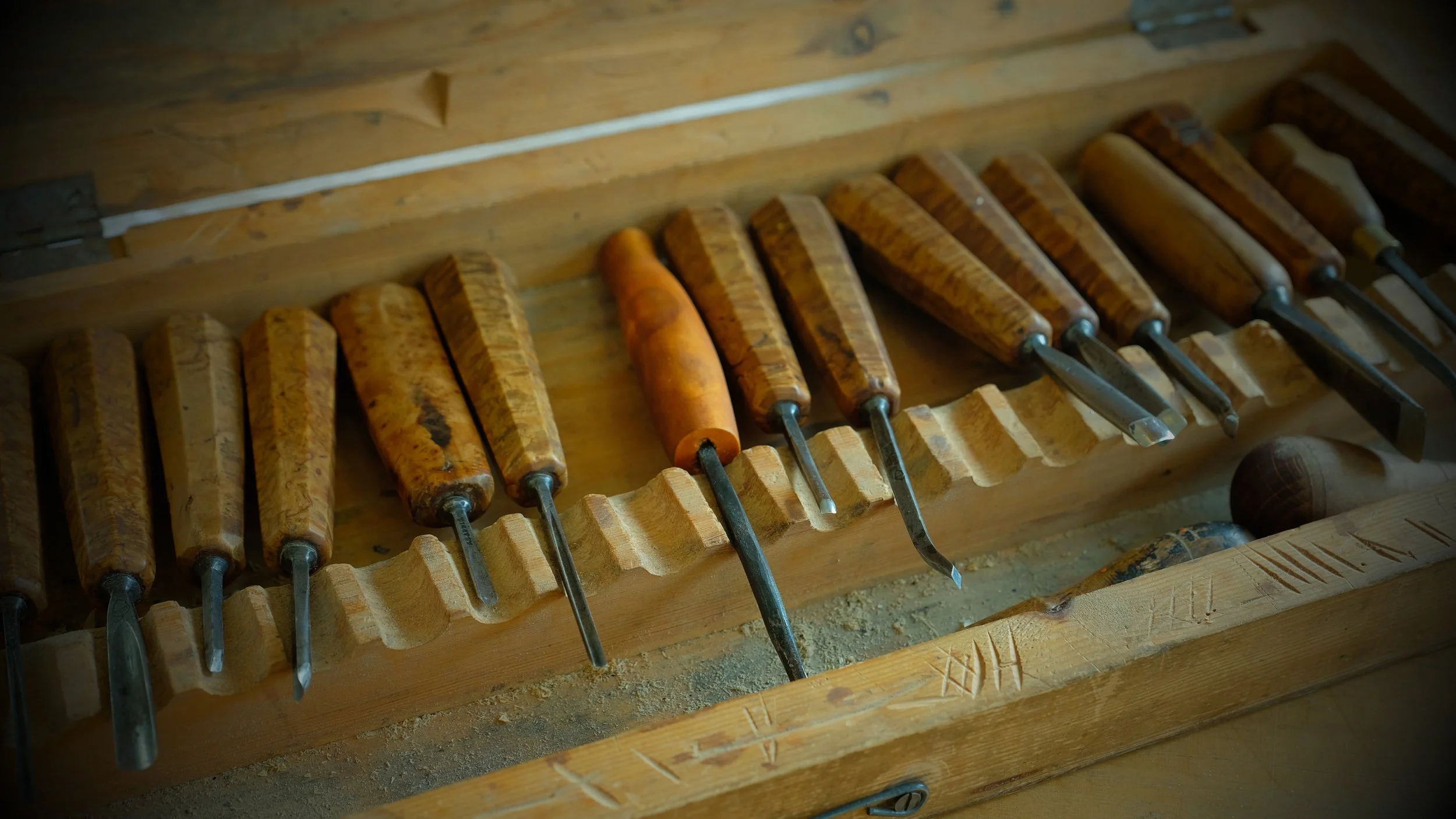
This model of practice—iterative, responsive, and materially grounded—extends into the work of Johannes O. Myrum, who inherited Rustom’s carving tools and employed them throughout his own career. Trained under his grandfather, Hans Myrum, Johannes combined smallholding with carving, the latter serving both as an economic supplement and as a site of artistic development. His work reflects an awareness of earlier masters, including Jakob Klukstad, Jakob Sæterdalen, Syver Jotun, and Anders Tasmyrhaugen, yet does not operate through direct imitation. Rather, it situates itself within an evolving dialogue, in which form, technique, and proportion are continuously recalibrated. His output included both small and large-scale objects, as well as a significant number of grave markers in wood and soapstone, where carving intersects with commemorative function.
It is within this context of material continuity that my own practice has developed in recent years. Since relocating to Norway, I have become increasingly attentive to these localized traditions—often maintained within smaller communities and transmitted through familial or informal structures. Their relevance lies not only in their historical significance, but in their ongoing presence as living practices. To engage with them is not merely to reference a past, but to enter into a field of relations that continues to shape how objects are made.
This influence is not confined to a single work, but extends across different projects within my practice. In the carving of the Ålesund voice flute—documented separately through both visual and written material—the sensibility encountered in Johannes O. Myrum’s work informed aspects of the ornamental approach. This did not take the form of direct replication of motifs, but rather manifested in the handling of depth, rhythm, and the relationship between structural form and surface articulation. The encounter with his tools and the study of his objects thus operate not as isolated references, but as an ongoing point of orientation within my work.
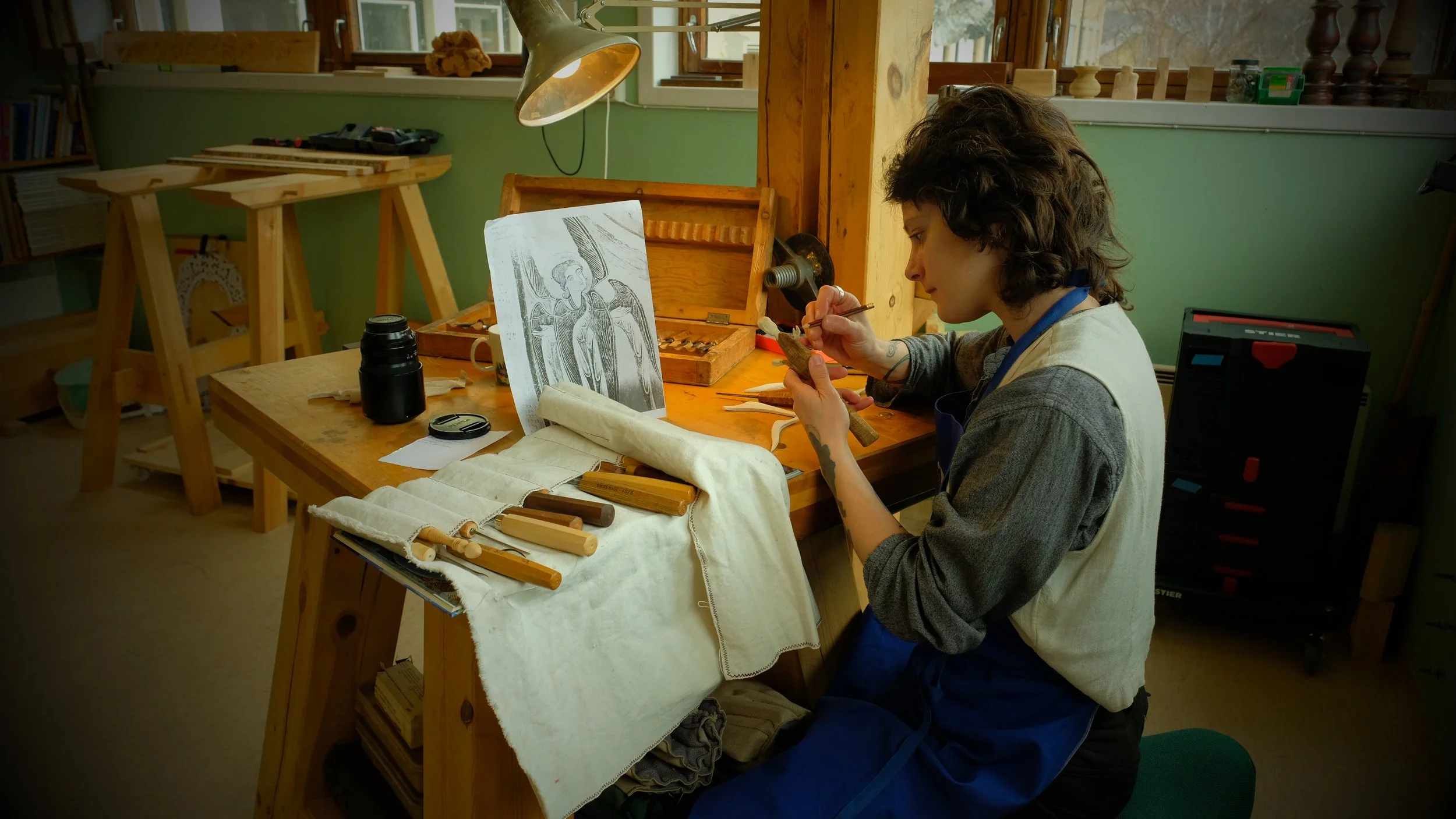
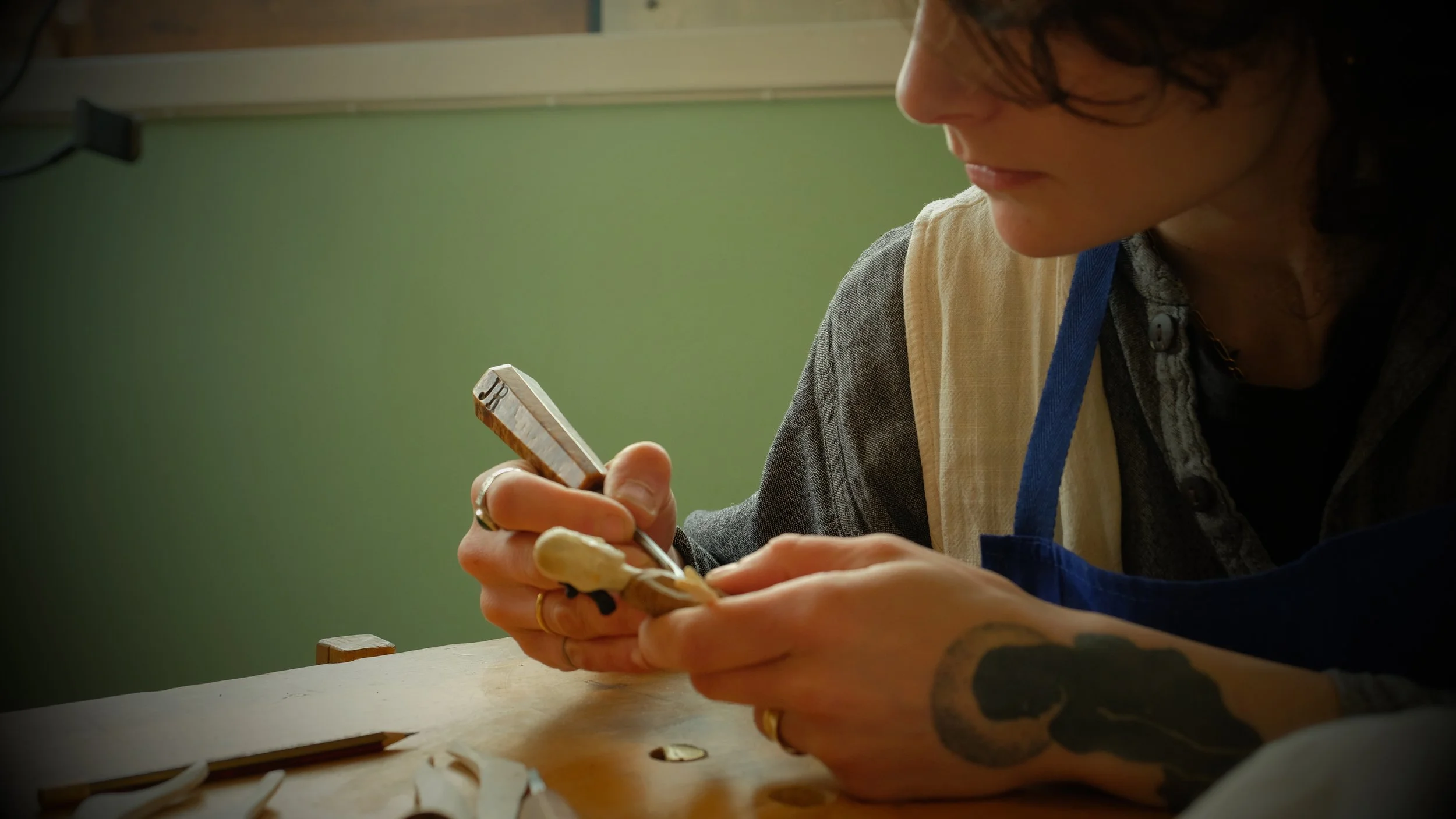
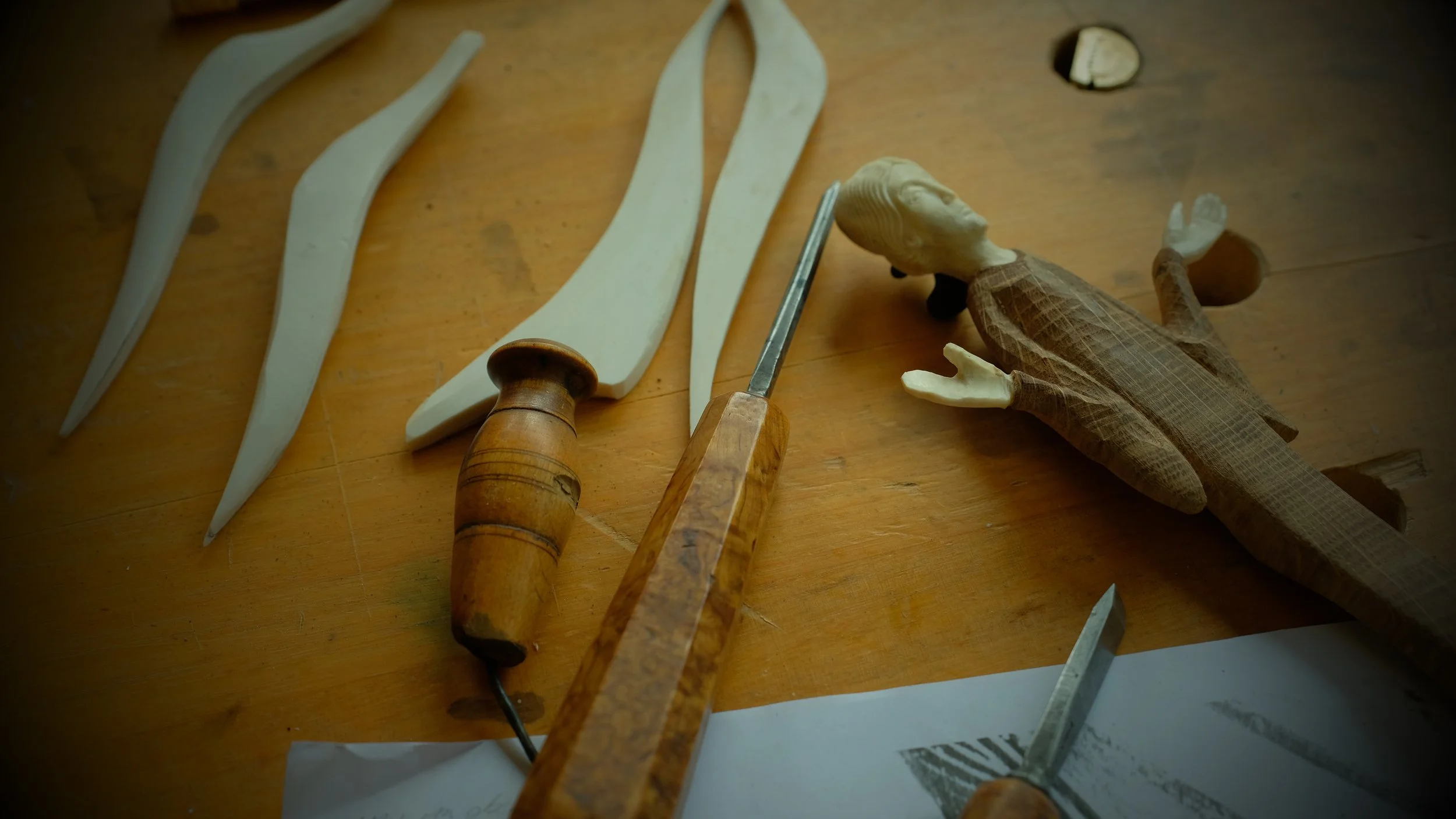
Concurrently, my practice has moved toward increasing degrees of refinement and reduction, particularly in the direction of miniature carving. This shift is not solely aesthetic, but also methodological: the smaller the scale, the more pronounced the negotiation between tool, material, and gesture becomes. At this level, each incision carries structural consequences, and the material’s resistance is no longer background, but an active determinant of form.
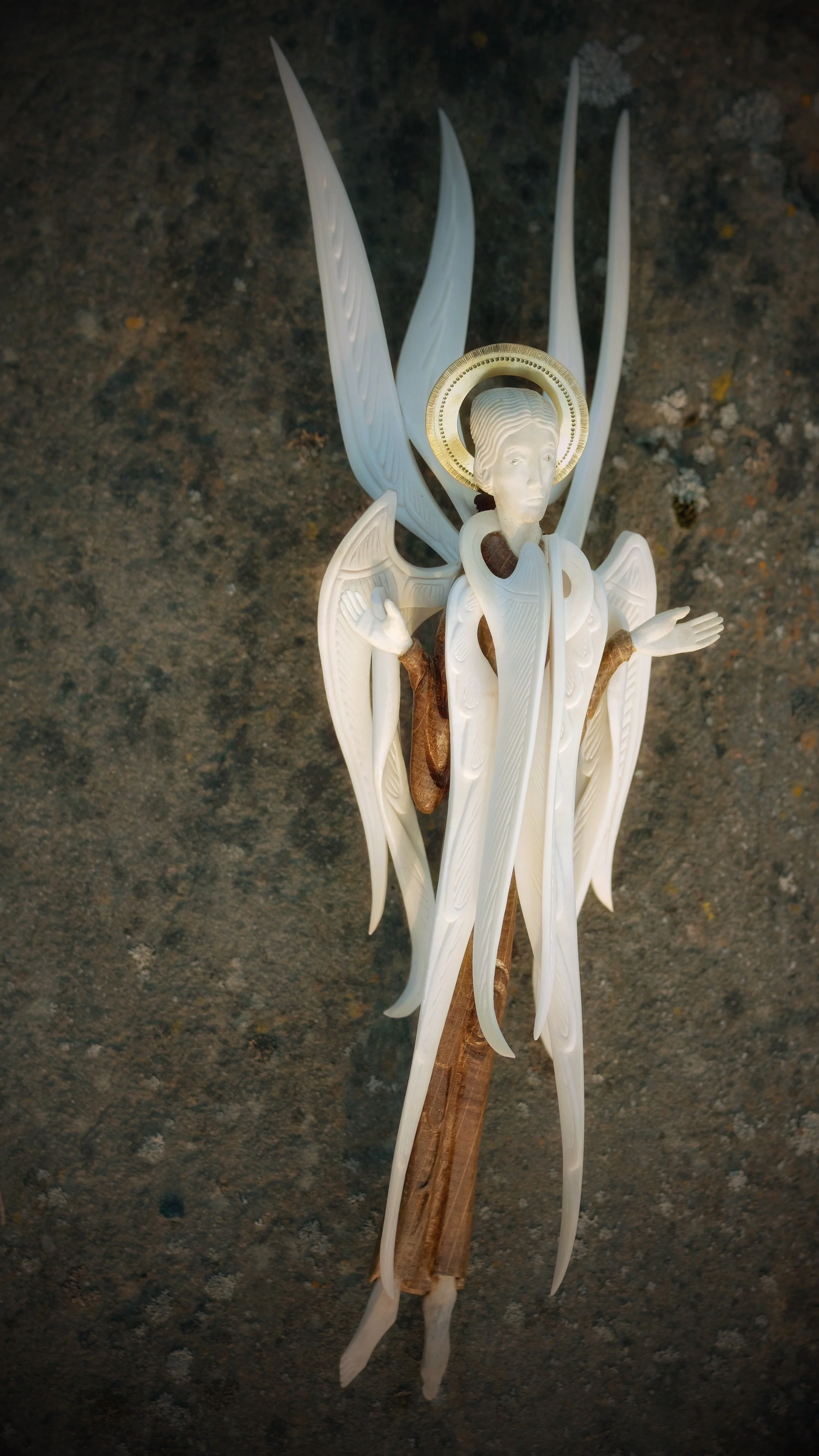
A recent work, a miniature carving of a seraphim, developed within this intersection of historical awareness and material inquiry. The figure is executed in oak, worked in the end grain—a choice that allows for heightened density and precision, while simultaneously demanding a more controlled and deliberate approach to cutting. The composition incorporates multiple materials: African blackwood for a concentrated detail; deer horn for the hands, feet, and face; elk bone for the wings; and brass for the areola and the iris of the eyes. Each material introduces distinct mechanical properties—variations in hardness, grain structure, and elasticity—which in turn influence both the sequence and the manner of execution. The process is therefore not governed by a fixed design, but unfolds through continuous adjustment to these constraints.
The iconographic basis of the figure derives from a 12th-century fresco located in the crypt of the monastery of Kloster Marienberg in South Tyrol, Italy. This reference establishes a further layer of continuity, linking the work not only to Norwegian carving traditions, but also to a broader European visual and devotional context. The resulting object, produced as a private commission and now located in Germany, thus operates across multiple geographies, situating itself between origin, influence, and destination.
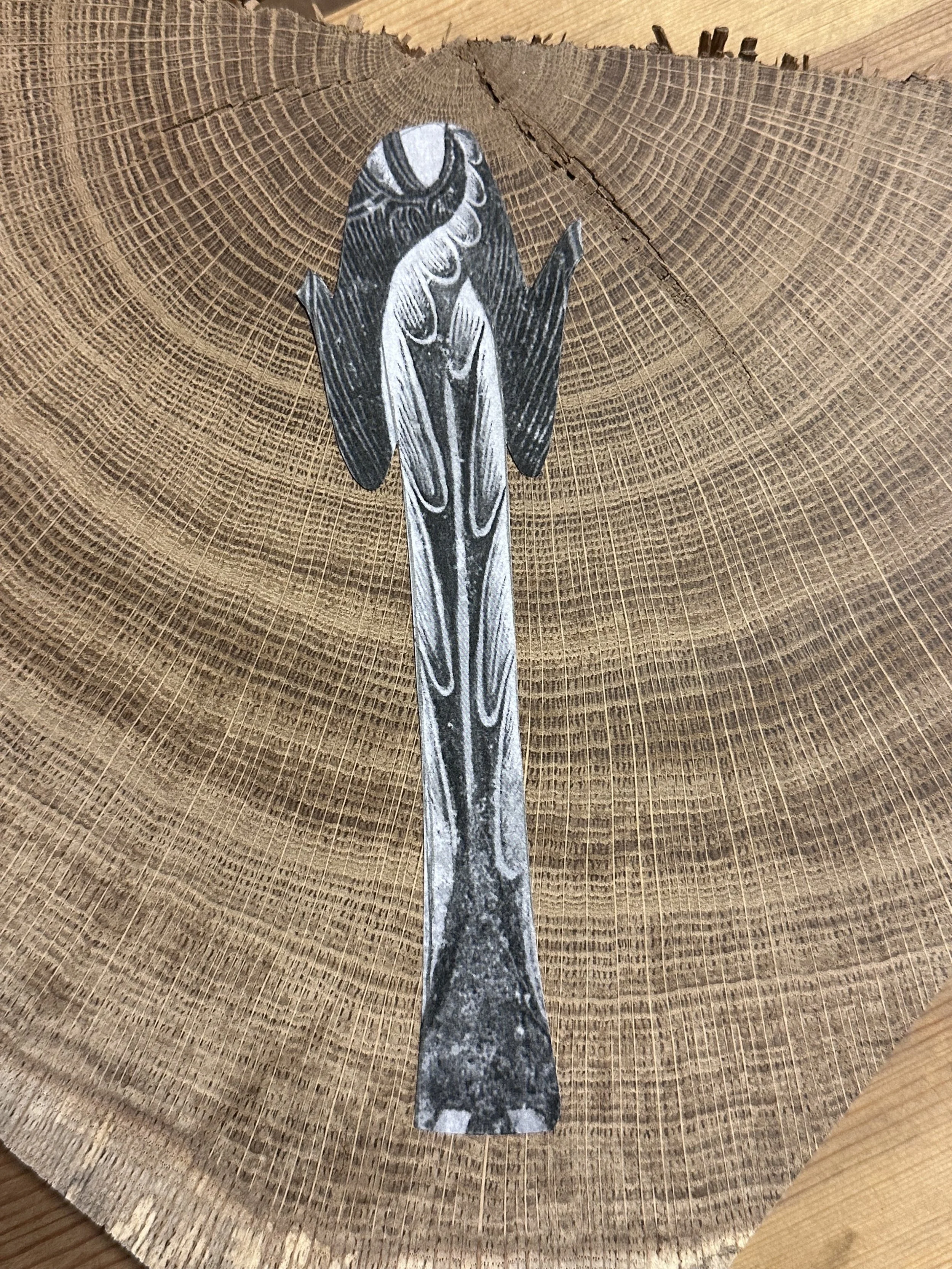
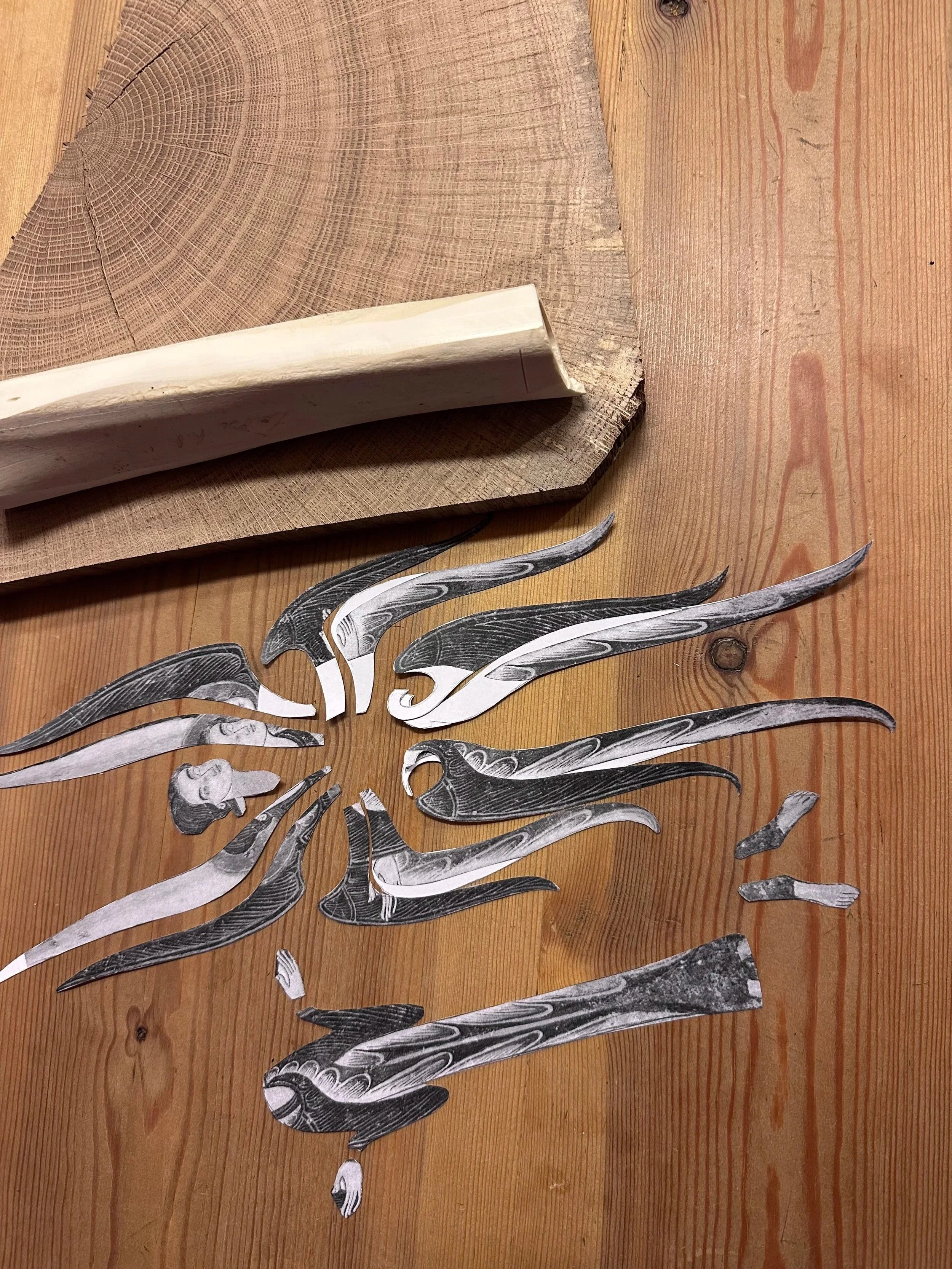
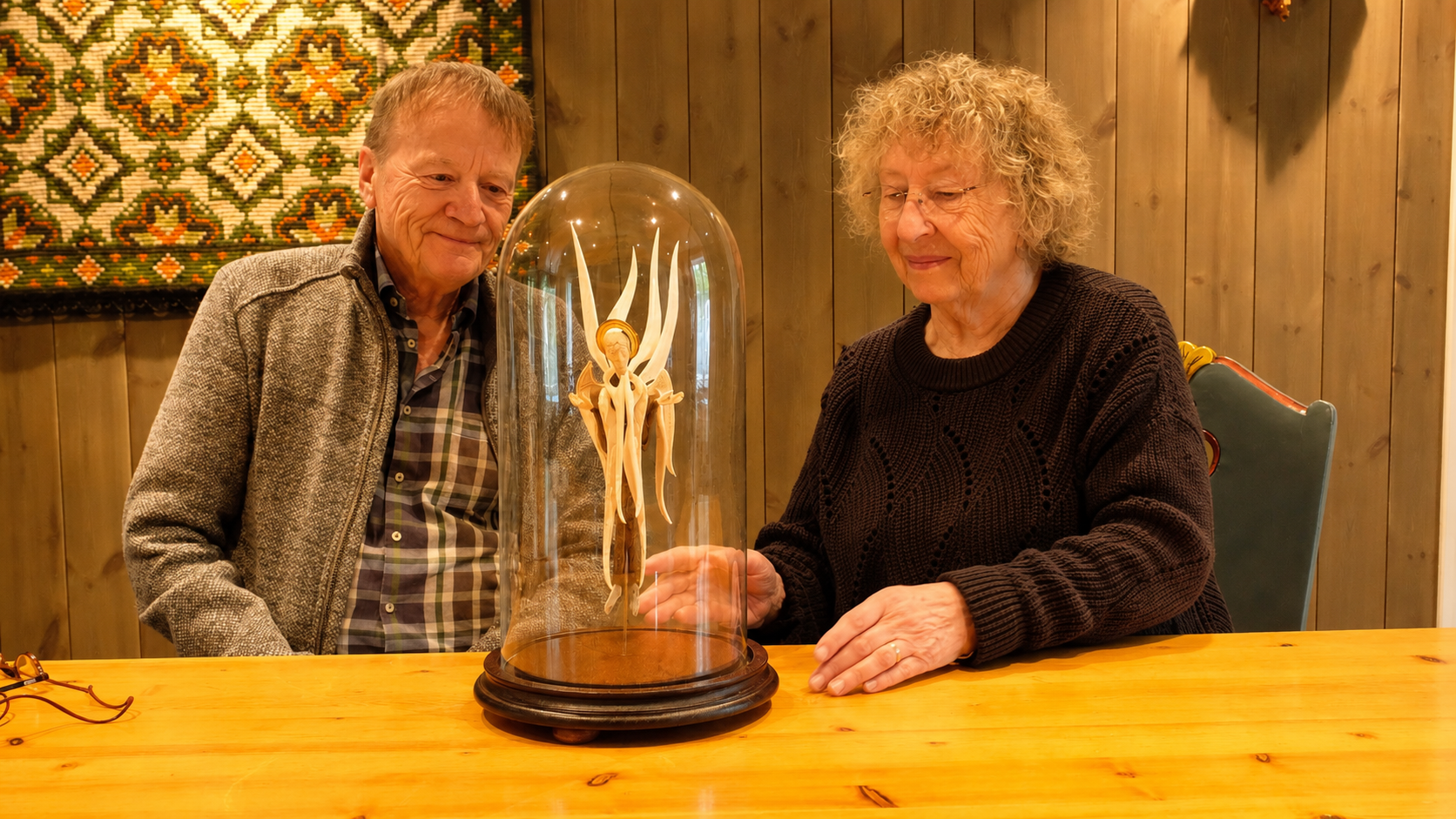
A critical dimension of this work lies in the tools employed during its making. The carving was executed, in part, using the original tools of Johannes O. Myrum. Their condition—still sharp, balanced, and fully functional—attests to a sustained practice maintained with care and precision over decades. The use of these tools does not constitute a form of historical reconstruction, but rather an extension of their operative life. Their edges retain not only technical adequacy, but also the accumulated decisions of prior use, embedded in subtle variations of geometry and wear.
In this sense, the act of carving becomes a point of convergence between temporal layers. The work on the seraphim is not only shaped by contemporary intention, but also informed by the residual presence of earlier practices. This does not manifest as stylistic continuity, but as a shared orientation toward material: an attentiveness sustained over time, in which making is neither purely instrumental nor purely expressive, but situated in a continuous negotiation between both.
Such practices resist clear separation between past and present. Instead, they suggest a mode of working in which historical knowledge is neither abstracted nor replicated, but activated through use. The tools, the materials, and the gestures form a network of relations that extends beyond individual authorship.
It is within this framework that I locate my own work: not as an isolated production, but as a situated act within an ongoing tradition, where continuity is maintained not through preservation alone, but through the repeated, attentive act of making.